slogs
Full Stack Developer
The problem
SIATA (Metropolitan Early Warning System) needed a platform to manage terrestrial and maritime logistics shipments at a national and international scale. The system had to cover the full cycle: client registration, product catalog, warehouse and port management, shipment guide creation with data validation, and status tracking for each dispatch.
The challenge was twofold: meet the functional requirements with precise business rules (volume discounts, vehicle plate and fleet number validation, unique tracking numbers), and demonstrate design judgment in the architecture, code quality, and technical decisions — the factors that differentiate a Senior profile from a Junior one in the evaluation.
The solution
slogs (Siata Logistics System) is a full-stack application with a fully separated backend and frontend, independently deployed to production.
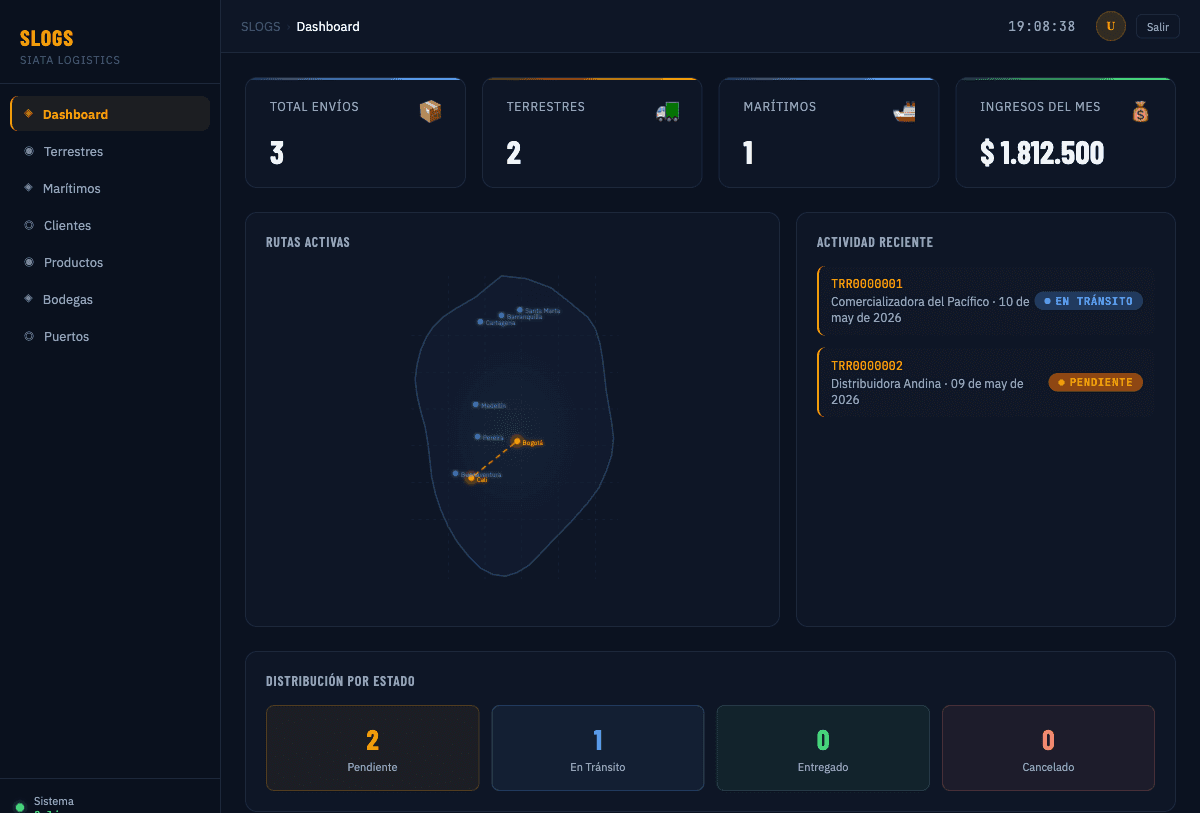
The dashboard centralizes real-time business KPIs: total active shipments, terrestrial/maritime breakdown, monthly revenue, and an interactive map of active routes with Colombia's logistics nodes (Bogotá, Medellín, Cali, Cartagena, Buenaventura, and more). The recent activity feed shows each tracking number's status with its associated client.
The implemented modules cover the full spec:
- Terrestrial — delivery plan with product type, quantity, dates, destination warehouse, price, vehicle plate (format
AAA123), and tracking number (10 alphanumeric characters) - Maritime — delivery plan with destination port, fleet number (format
AAA1234A), and the same uniqueness and quantity validations - Clients, Products, Warehouses, Ports — full CRUD for each entity
Business rules are encapsulated in the backend service layer: automatic 5% discount on terrestrial shipments with more than 10 units, 3% for maritime, and exhaustive validations before persisting each record.
Bonus features implemented include JWT bearer token authentication, full REST API documentation, error handling with appropriate HTTP codes (400, 401, 422, 500), and SPA navigation on the frontend.
Technical decisions
Python + FastAPI for the backend — the spec required it, and FastAPI is the natural choice for modern REST APIs in Python: Pydantic typing, automatic OpenAPI/Swagger documentation, async performance, and declarative payload validation. Complex business rules (discounts, plate format with regex) live in the service layer, separated from controllers.
PostgreSQL as the database engine — the most solid of the proposed options for modeling the relationships between clients, shipments, products, warehouses, and ports. The ER model was designed before writing any code, with foreign keys and constraints that make it impossible to create a shipment without an associated client at the database level, not just at the application level.
Next.js + TypeScript for the frontend — real layer separation, end-to-end typing, and an SPA with smooth navigation that avoids page reloads. Choosing Next.js over a plain SPA (CRA or Vite) was intentional: it demonstrates judgment for picking tools with a long roadmap and mature ecosystem.
Separate deployment — frontend on Vercel, backend on an independent service. This architecture is more complex to configure but reflects how real production systems are deployed.
Results
The system covers 100% of mandatory requirements and 7 of the 8 optional bonus features — a result the assessment defines as a Senior-level evaluation criterion.
The most interesting part of the exercise wasn't the implementation itself, but the design decisions that differentiate it from a Junior solution: layer separation (router / service / repository), database-level validations in addition to application-level ones, consistent error handling throughout the API, and a frontend that consumes the API in a typed way without duplicating business logic on the client.